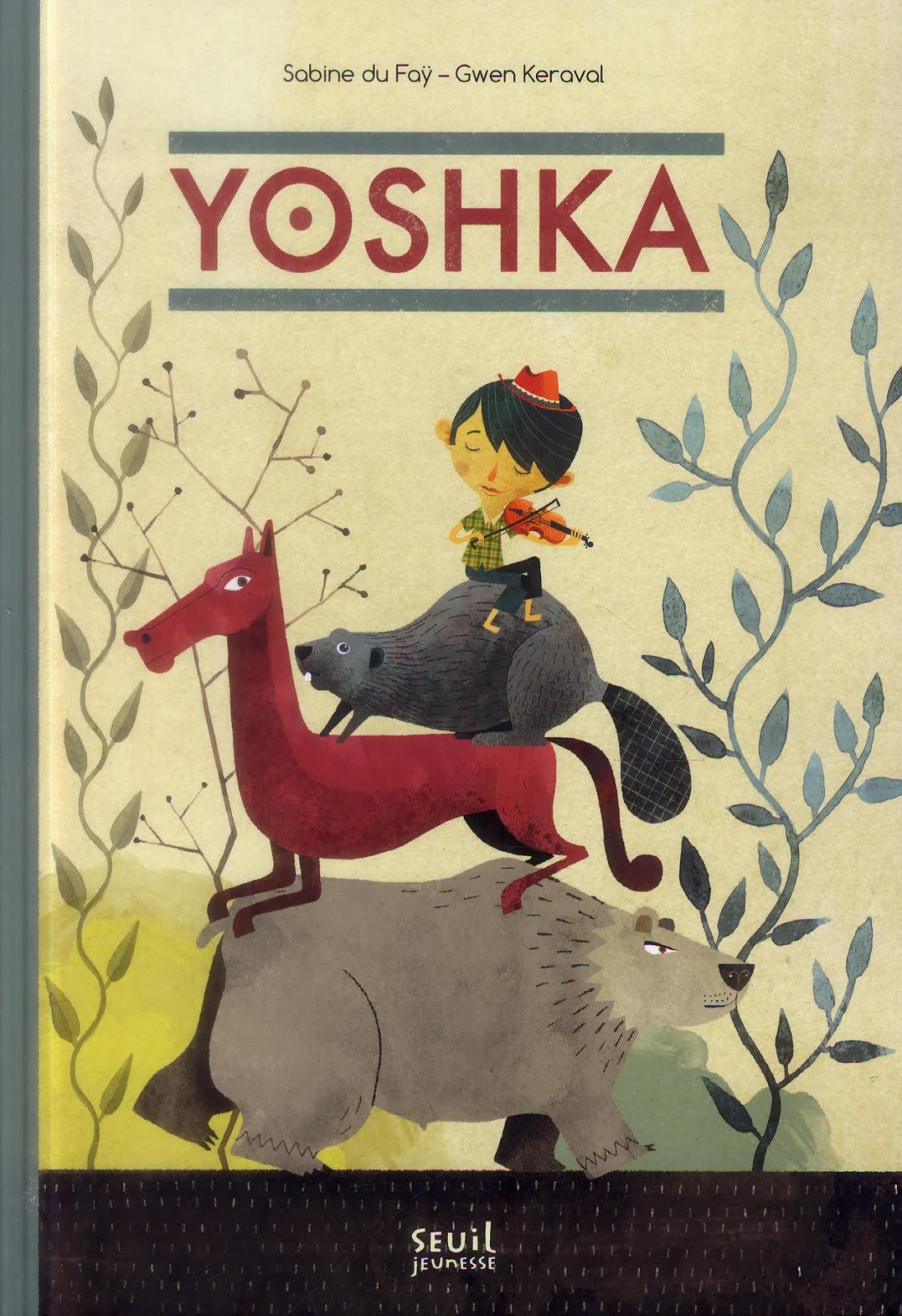
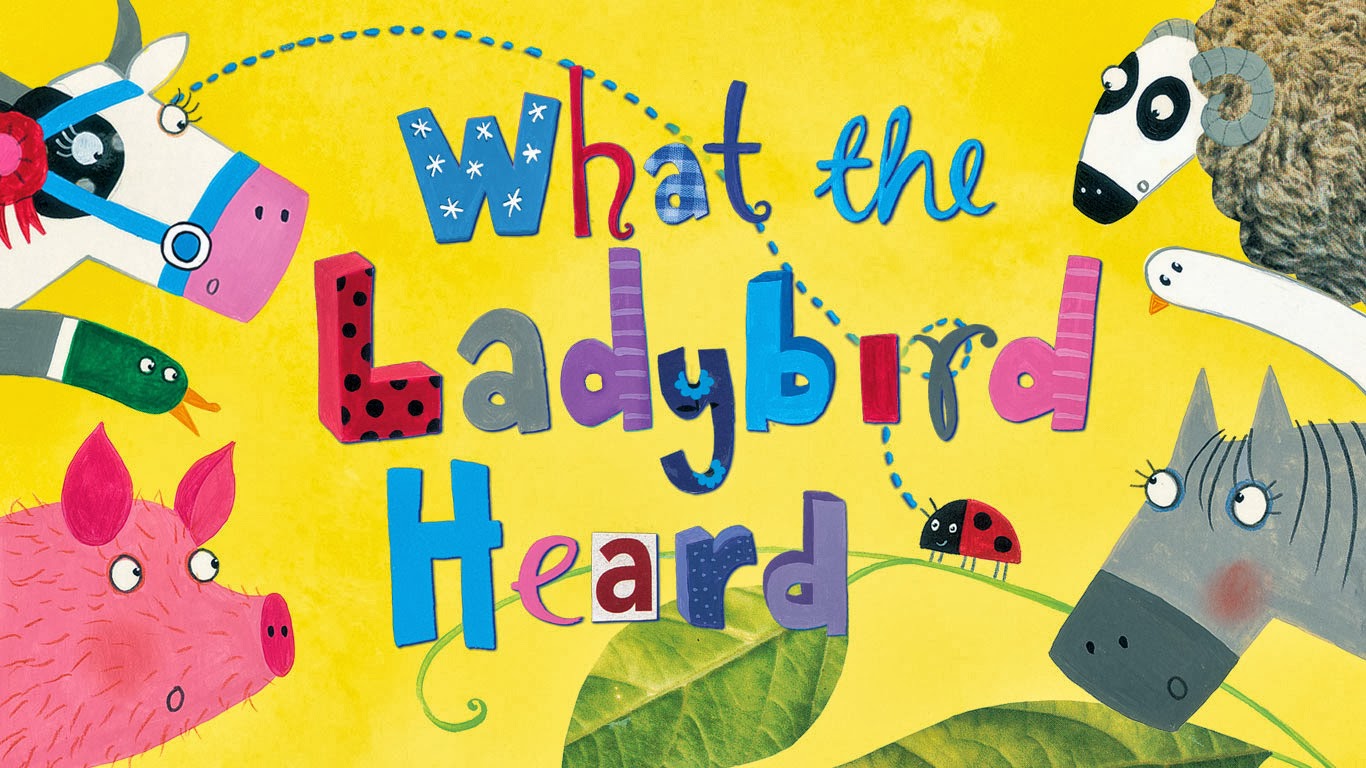
Showing posts with label children books illustrators. Show all posts

Activity of the Week

Each week I work with over 50 children, teaching them English or working on developing other skills through the Montessori educational method. It has become part of my philosophy to individualize each lesson according to each child. Once in a while though, certain activities prove to be of great success with almost all children, so I suggest them to others as well.

A popular activity of the last week was enhancing the wild animals vocabulary, through listening, singing, reading and discussing with the help of two great instruments from Barefoot Books: Walking Through the Jungle video and book by Stella Blackstone, illustrated by Debbie Harter and sung by Fred Penner.

Firstly, the children watch and listen to the video:


I often played it twice, firstly because the children asked for that, and I wanted to follow their interest, secondly because I asked them to focus on what they see, then on what they hear.


Afterwards, I took out the Walking Through the Jungle book, with similar illustrations. The children loved the colorful images, and graphic of the animals. I liked the book because it presents animals together with the environment they live in, thus making it easier for them to build later on connections with countries and continents.

With the help of the book, taking into account the level of development of each child, the following activities can be done:


  1. Reading the lyrics of the song. Through repetition they consolidate their reading skills, and gain confidence to read further. 
  2. After reading comes translation, for the ESL children. Make sure they all understand what they are reading / saying.
  3. Identifying each animal in relation to the environment. If you have world maps, globes or puzzle maps, it would be a good way to take the learning further and associate each environment with its place on the map.
  4. Discussions on animal behavior. Make sure they know it is normal to be afraid of these animals and to stay away from them because they might be dangerous. In the book, characters are running from the ferocious wild animals, but in the end they all gather together for supper, giving a positive psychological closure of the adventure, but also a humorous creative ending. The children laughed about what each animals was eating and how the whale "poured" water for the girl. This type of creating ending could stimulate their imagination. Some questions for that can be: What would happen if these wild animals would come at your home for dinner? What would you feed them with? 
  5. Grammar activities focusing on the lyrics. Children can identify, write or mime each of the action words (verbs), naming words (nouns) or describing words (adjectives).
  6. If you have sets of plastic wild animals you could take the activity further by sorting out the animals they have seen in the book / clip. To further consolidate classification they could be sorted by color, environment, what they eat, certain skills they have such as swimming or climbing, etc. 
  7. Painting or drawing with the book illustrations as inspiration. Each child can make his/her own version of the jungle, the desert or any other place described in the book.
I am sure this list could go on with endless activities that can build or consolidate learning. What other books related to wild animals do your children enjoy?
Have a great week, full of wonderful, sparkling learning moments!


Two by Two: Two Montessori Inspired Books for Preschoolers

Two by Two is an exciting children literature project. Its purpose is to bring more or less known children books in the attention of teachers, parents and children around the world, paired on specific themes such as death, communication, self esteem, anger management, friendship or unconditional love. A lot of these books were brought to my attention by a very dear friend, with whom I share  the passion for child literature. Almost all of these books are in my personal library, carefully chosen to fulfill some of the criteria described here, and have been used during my teaching classes. The children I work with had wonderful reactions to them, and this has inspired me to write this Two by Two series.


Maria Montessori was a remarkably bright girl who grew up to shake the foundations of the traditional education system. Although her method is becoming increasingly popular (you can read a detailed article about it here), there still are many less known facts about her life. She grew up in a period when women were not allowed to vote or to make decisions for themselves. She was one of the first Italian girls to be allowed public education. She challenged the norms by deciding to take technical studies, then switched to medicine. She was sensitive but strong willed and liked to do things her way. She was a fast learner and quickly adopted good case practices from around the world and took on the challenge to work with very disadvantaged children. She then grasped the first opportunity to work with normal children and by observing them and their needs, she designed materials and activities that could help them grow happy and independent. She lectured in countries around the world and assisted in the opening of many Montessori schools. She refused Mussolini when he demanded fascism to be taught in her schools and relocated several times. She met Gandhi, Nehru and Tagore. She received three nominations for the Nobel Peace Prize. These are some of the reasons why I chose this first article of 2014 from the Two by Two series to cover two Montessori inspired books!


1. Montessori Shape Work, by Bobby George, June George, Alyssa Nassner (Illustrations)

Although the third in a series of books created by the same authors, I believe it should be the first to be introduced to children, as they encounter shapes in their environment much earlier than they recognize and understand the numbers or the letters. Unlike other books presented in the Two by Two series, this one does not stand out because of stunning illustrations. As Montessori advocated for children to be grounded in reality at early ages, the pictures show colorful real-life objects which can help children spot the shapes in their own environment or outside of it.

Throughout the book, shapes are introduced three by three, from three different types of triangles (isosceles, equilateral, right-angled); to three different types of rounds (circle, ellipse, oval); to three different types of parallelograms (square, rectangle, rhombus); and three different types of polygons (pentagon, hexagon, octagon).

What makes this book more special than other shape books is the fact that it contains die-cut shapes for children to trace with their fingers, thus working towards imprinting the shapes in the "kinesthetic" or "muscular memory" of the child. 


2. Montessori Number Work, by Bobby George, June George, Alyssa Nassner (Illustrations)

Like all of the three books in this Montessori series, the number book is also a board book meant to stimulate the child's learning through visual and tactile senses. Accompanied by an adult, the hearing sense comes to help as well, as children discriminate the sounds used for each of the symbols that represent the numbers.


Similar to the other books, the first page hosts a Parent Letter, during which the method used is explained. Again, the book is accompanied by real life objects to count, numbers to trace, and the corresponding number rod!


Number rods  is the first of a series of brilliantly designed mathematical instruments that Montessori created with the purpose of teaching children numeracy and arithmetic. As the child counts through the objects, s/he begins to make the correlation between the quantity, symbol, touch of the symbol and sound, and ultimately the corresponding number rod.


The last book of the series is simply called Montessori: Letter Work and it builds up on the skills gained in the two previous books. I really love these books because they conveniently have some of the attributes of the Montessori materials packed in elegant, practical, simple board books that respect some of the Montessori principles and help the child make connections between concrete and abstract with the help of their senses.


These books are an excellent tool for home or classroom learning. I hope they make you at least a bit curious about Montessori and her method! Feel free to contact me at alexandra.asofie@gmail.com for any questions you may have related to that! I am happy to share my knowledge with any education enthusiast!


Source of Images:


  1. http://wmontessori.com/german/wp-content/uploads/2011/06/maria-montessori-249x300.jpg
  2. http://vibrantwanderings.com/wp-content/uploads/2012/08/20120830_180734-558x600.jpg
  3. http://www.howwemontessori.com/.a/6a0147e1d4f40f970b017ee40879d5970d-pi
  4. https://blogger.googleusercontent.com/img/b/R29vZ2xl/AVvXsEhKUpgJpxeOZtLR7IerP3D0bd3YR5munPn831LbI8jeKk6gPoHEwklrLP6XnuuKnHr-0YQCWZh-UUl5_Q7yDCkHJu-FEJ4c-QbafVKXWeqSuL8NniC2aqogXUEG1U-J3UMtaiwy5FHL-Os/s1600/Montessori_NumberWorkSpread01-2.jpg
  5. http://www.montessorialbum.com/montessori/images/c/c0/Number_Rods_9.JPG

Bibliography

Standing, E.M., Maria Montessori: Her Life and Work (New York 1984)

Two by Two: Two Children's Books for a Good Night's Sleep

Two by Two is an exciting children literature project. Its purpose is to bring more or less known children books in the attention of teachers, parents and children around the world, paired on specific themes such as death, communication, self esteem, anger management, friendship or unconditional love. A lot of these books were brought to my attention by a very dear friend, with whom I share  the passion for child literature. Almost all of these books are in my personal library, carefully chosen to fulfill some of the criteria described here, and have been used during my teaching classes. The children I work with had wonderful reactions to them, and this has inspired me to write this Two by Two series.


Two by Two: Two Children's Books for Good Night's Sleep

1. Silly Billy, Anthony Browne

Anthony Browne is an amazing British artist! I really love both his illustrations and his stories. The stories are original, profound and insightful and deal with different facets of childhood. His illustrations are brilliant! They are often full of hidden meanings which children can discover gradually. Browne  uses different characters from famous classical paintings to educate children on the history of art or to express certain feelings in an unconventional way. He also uses gorillas as characters, being inspired by real stories and the contrast between their strength and their humanity and gentleness.  


Silly Billy is a book that can help children deal with anxiety and some of the fears they face when they go to bed. Browne leaves nothing to chance. If you carefully analyze the cover you will see something that looks like a doll, with a sad face, and a boy walking towards the future with a happy face. These two clues make you curious from the start to discover Billy's story and why he's called silly in the title. 

From the very fist pages we find out Billy was a boy who would worry about a lot of things. Not to give children ideas of real things to worry about, the author had Billy worry about hats and shoes, clouds and rain and giant birds, fears that are not at all common among children. The use of black and white for the illustrations of Billy's fears are very compelling. Browne also makes references to the work of Magritte by using his style of drawing the hats.


Of course his parents tried to talk to him, and reassure him they are there to protect him. But for Billy this was not enough. One night, he had to sleep at his grandmother's house.  He got particularly worried when he slept in other places, and and his anxiety grew, he felt a bit ridiculous and went into his grandma's room. 


His grandma reassured him that he wasn't silly at all! She then came with a solution for his worries, some worry dolls for him to tell all his worry to, and put them under his pillow. They would take his worries for him, and he could sleep in peace. Billy tried the worrying dolls and for three days he slept very well. 


But soon, Billy got worried again! He felt bad for the worry dolls, to carry all the weight of his worries for him, so he decided do to some crafty work and make some worry dolls for his worry dolls!

And that was the end of Billy's worries. At the end of the book we get a short explanation. These worry dolls actually come from Guatemala, where children would make them from wood, colorful pieces of cloth and thread. They have proven to be quite useful for children, and today they are even used in certain hospitals to help children deal with their fears. 

Many teachers accompany this books with discussions about fears or with practical activities. The dolls are easy to make. Here is an example of a doll making activity inspired by the book. Another example of activity is this animation made by the children of Columbia Primary School for the London's Children Film Festival (2009).  You can find many articles and interviews with Anthony Browne on the internet. Here is a series of 6 clips from a conference where he spoke about his inspiration and the stories behind his books and illustrations!


2. The Little Giant, Philippe Dumas

For the second book I choose one a little bit easier and with no negative emotional charge. Philippe Dumas's story is perfect for a warm, cosy, full of fantasy bedtime read.

The book has a witty start as the author presents the two main characters: a boy and a girl who broke anything and never spoke bad words. The little readers are reassured as they flip the page and discover the boy and the girl were two plastic dolls!

The owner of the dolls, a little giant girl, was happy to play and sleep with them. During the day, she was a giant, but at night, she would lessen into their size and they would tip toe out of their room and eventually out of the house. They would travel on the dog and roam the fields at night. Run through the wind, watch the stars, the animals of the night, the sounds of the nature. They would swim with the ducks and make fire for the butterflies. They would then stop at the rabbits den, where they would be awaited with tea or warm onion soup, listen to stories, then sit on trees with the crows and pass by the cows in the field on their way back. As the night grew shorter they would hurry back home. The little girl would regain her normal size. And as soon as they jumped back into bed the morning light would come trough the window, and together with it, the biggest giants would come into the room to say good morning! 

For me this story is more than just a simple tale. With the help of beautiful, colored illustrations, it proposes an exercise of imagination, empathy and a lesson for both children and adults on how the world is scaled and the magic of childhood. As a montessorian, this book is perfect not only for children but for all the adults who yet need to understand the relevance of child sized environments for their children's proper development!

Two by Two: Two Children's Books that Teach Colors Unconventionally

Two by Two is a new exciting children literature project. Its purpose is to bring more or less known children books in the attention of teachers, parents and children around the world, paired on specific themes such as death, communication, self esteem, anger management, friendship, learning about colors or numbers, unconditional love, etc. All of these books are in my personal library, carefully chosen to fulfill some of the criteria described here, and have been used during my teaching classes. The children I work with had wonderful reactions to them, and this has inspired me to write this Two by Two series.


Two Children's Books that Teach Colors Unconventionally


1. Little Blue and Little Yellow, Leo Linonni


Leo Leonni is by far one of the genius illustrators and writers of child literature. His genius lies in the simplicity with which he can talk, both in writing and through his images, about complex things. Little Blue and Little Yellow is not only about colors but about friendship and feeling positive and negative emotions and how these emotions can transform you.

It's the story of two good friends, who enjoyed each-other's company and had many other friends with whom they played hide and seek and other interesting games. One day, Little Blue seemed to have lost little Yellow, as he searched for him all around. When they


finally find each other, they hug so strongly, they both become green! Although happy with this transformation at the beginning, it soon becomes a burden. When their parents see them they don't recognize them anymore. Torn up with emotions Little Blue and Little yellow start to cry,


and their tears are blue and yellow. Released from their emotions they become once again Little Blue and Little Yellow. When they go home to share the story, a hugging revolution begins, and both family and friends experiment with this new thing, while reinventing themselves in lots of different colors!


2. The Great Blueness and Other Predicaments, Arnold Lobel


Lobel isn't so popular nowadays, he was well known in the 70's and 80's, especially in the United States, and today you might recognize his work from the Frog and Toad book series. His illustrations are rather classic but expressive, quite a different style from the minimalist Lionni. His stories may seem traditional, but they always come with a twist.

The Great Blueness and Other Predicaments tells the story of a magician, who would wake up every day and think that there is something missing in the grey world he lived in.

Often he would go down in his gloomy cellar and begin doing all sorts of magic tricks to forget about the world he lived in. In these playful experiments, mixing this with that, one day he created something different. He decided to make good use of it so he went outside and spread it all over his house. It was the color blue, and his neighbors got so excited that they demanded more of it so that they could also paint their houses. In short time everything was blue. 


But soon they all began to loose their smiles and feel very unhappy. So the magician decided to go back in his cellar and try something new. He added bits of this and bits of that and he created yellow.  The people were again enchanted with the new trick and used it plentifully to paint every nook and cranny with it. Until yellow too became too much for everyone. Then our magician turned to more mixing and merging and came up with red, which of course, everyone loved and used to fill the streets, houses, fences and pebbles. Until everyone became so very angry they began throwing stones at the poor magician who was himself red with anger. 
  
Once again, the magician began to blend and merge but all he could come up with was just blue, red and yellow. He kept on making more and more until the barrels overflew with colors which started to mix. With great joy, the magician found the solution he was waiting for. He presented it to all the people in the land who began to paint their world with all the colors the magician had created. 

I loved the story and the association between feelings and colors. I loved his somewhat medieval drawings and the step by step approach to introducing the primary colors. 


There are many other books which aim to teach colors in innovative ways. From simple bed time story telling or reading to a group to complex artistic representations, they can stimulate imagination and creativity! Here is an example of how a school in France was inspired by Lobel's story! 

Hope you enjoyed these two books as much as I did and that this article will inspire you to give the most beautiful colors to childhood! 


Two by Two: Two Children's Books that deal with Loss

Two by Two is a new exciting children literature project. Its purpose is to bring more or less known children books in the attention of teachers, parents and children around the world, paired on specific themes such as death, communication, self esteem, anger management, friendship, learning about colors or numbers, unconditional love, etc. All of these books are in my personal library, carefully chosen to fulfill some of the criteria described here, and have been used during my teaching classes. The children I work with had wonderful reactions to them, and this has inspired me to write this Two by Two series. 


Two Children's Books that deal with Loss

1. Rabbityness, Jo Empson

During one of my trips to Waterstones one book popped into my eyes. Its cover looked like one of Pollock's colorful explosions with the smiling face of a black, rather silly looking rabbit in the middle. I picked it up, then noticed it had a "Waterstones Children's Book Prize" Sticker on it, which I suppose further determined me to poke my nose into it. Then once I opened it, I couldn't stop reading until the end. 

Rabbityness tells the story of a rather unusual rabbit, who, beside being a normal rabbit with normal rabbit habits, also had some unrabbity artistic passions: painting and making music. His passions made him so happy that he became an inspiration for all the other rabbits, who joined him in filling the woods with color and music. 

One day, Rabbit disappears and the other rabbits were very sad. The woods were quiet and grey and all that was left of Rabbit was a deep dark hole. But in that hole, rabbit left some gifts for them: things to make colors and music! And once again, with the gifts from rabbit, the forest was filled with wonderful joy, with music and drawings and paintings made by very happy rabbits, who discovered that they too loved doing unrabbity things!

I very much loved how the author combined bits of reality with fantasy, how she made it so simple for children to identify themselves with the rabbits. I also loved the metaphors: the big dark hole is the void the loss of someone dear leaves behind, but in it, the author shows, we can always find the gifts those dear ones leave behind, colors and music for our wounded souls. This is an excellent writing about loss, inspiration and creativity! Last but not least, the illustrations are amazing!


2. The heart and the bottle, Oliver Jeffers


Oliver Jeffers is one of my favorite authors and illustrators. His work is simple but very meaningful, warm and subtle and his art is often made with a combination of drawings, paintings and real photography collage. 

The Heart and the Bottle teaches us about the beauty of childhood and ways to deal with loss. The story goes like this:

Once there was a little girl whose head was filled with all the curiosities of the world. She loved to read, draw and explore the world together with a special someone, with whom she shared all her findings and her wonders. 


Until a day when all she discovered was an empty chair. She then decided to put her heart away in a safe bottle which she wore around her neck, until she grew bigger and bigger and the heart became heavier and heavier. 

It took meeting a little girl whose head was still filled with all the curiosities of the world to make her want to put her heart back. Once she did, she was again sensitive to all the wonders of the world. And the chair was not so empty anymore.
Dealing with loss is part of life, and I believe it is important to start talking to children about it even before they are faced with such events. Although we may never really be prepared for death, reading and talking about it helps both children and parents deal with some of their most powerful fears in a warm, positive way. These reading moments also strengthen the parent - child relationship, develop the child's vocabulary and reading or listening skills. There are many more children's book on this theme. You can find some of them in LH Johnsons's List

Enjoy the readings and the peace they may bring!

With love,

Alexandra


Children's Books: Which Ones Should We Choose?

Either you are a teacher or parent, if you are educated enough to read this post, it is likely you understand the role of books in a child's education. This post is not going to be about that, but about choosing the right kind of books, according to your child's/ children's needs and interests. And speaking of good books, it is impossible not to give you some clues of some of my favorite authors and illustrators.

Fist of all, here are 3 non-exhaustive criteria parents and educators should have in mind when choosing books for their children:

1. Correlation to age / development level - it's not bad to buy books in advance, but some children may get frustrated for not understanding the story or the meaning, not being able to read, etc. Choosing books for the right age and development level of the child can facilitate certain sensitive periods (Montessori ) and stimulate his/her quest for knowledge;

2. Message - many of the traditional, well known stories for children were a mirror of the society and its development back then, a couple of centuries ago. Stories of murders and revenge, deceit and violence were normally told in an age parents were advised to beat their own children and child development was not on top of the agenda - at home or in the scientific community. 21st century research has given us a few clues on the do's and dont's of child education and development. Today's books should reflect some of the things children need to hear about as they grow up: how to positively express their feelings, how to take care of themselves, how to socialize, or how to deal with loss or other traumatic experiences. So before buying a book double check if the messages of the book are aligned to your beliefs as a parent / educator and if they help your child develop in a positive way.

3. The illustrations - I always give an equal importance to the illustrations, because they can enhance or alter the message of the book. Beautifully illustrated books scream: "Pick me", they have live colors, out of the ordinary characters, they make use of more visual art techniques: drawing, sculpting, collage or painting, mixing real - life photography in fictional stories, mixing different painting styles and periods and providing different sensorial stimulation. These books have breath-taking, out-of-the-box, vivid imagery, unexpected surprises folding or unfolding, beautiful fonts in line with the story and the characters.


 You can find some of my favorite books and authors in the collage underneath! Can you guess the authors and the titles? Enjoy the quest for character-building books!